
Guarantees & surety
Trade Credit Insurance
Indemnifies a seller against non-payment by trade debtors through insolvency or protracted default, on a whole-turnover or key-accounts basis.
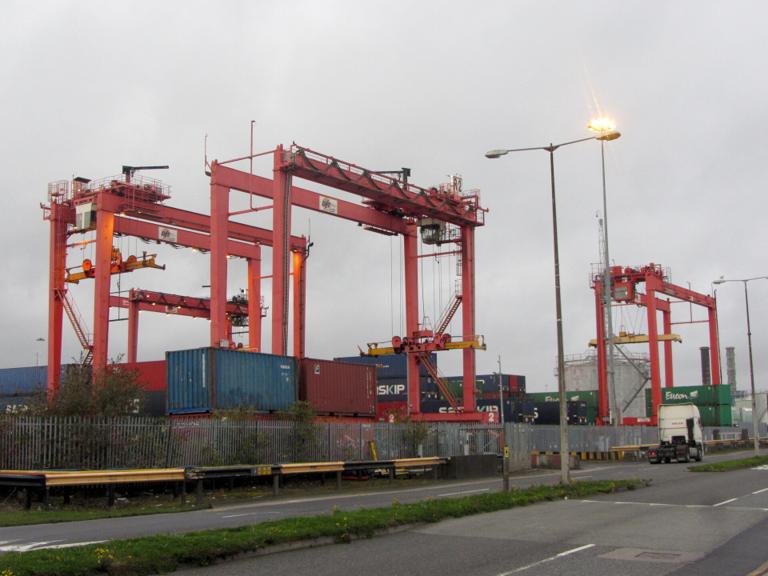
Boland’s Quay, Dublin · William Murphy, CC BY-SA 2.0
Who it is for
Businesses selling on open account terms in the UK, Ireland and the EEA
What it does
- Whole turnover, key accounts and single-buyer structures
- Credit limits set and monitored on each buyer
- Indemnity typically 85–90% of the insured debt
- Collections handled before a claim becomes a claim
The product in full
Trade credit insurance covers the receivables ledger. A business selling on 30, 60 or 90-day terms is lending to its customers, usually without security and often without a formal credit assessment. The policy indemnifies the seller when a buyer fails to pay through insolvency or protracted default, and it does so at a percentage — typically 85% or 90% — so the seller keeps a share of the risk and therefore keeps its own credit discipline.
The credit limit is the working part of the policy. Each buyer carries a limit that we set and monitor; sales within the limits are covered, sales above them are not. That makes the policy an underwriting service as much as an indemnity: the seller gets a continuously updated view of which customers are safe to grow with, which is frequently worth more than the claims.
The other half of the value arrives before a claim does. Collections are handled while a debt is merely late, not once it has become a loss, and a protracted default claim only crystallises after the waiting period — 120 days on our standard wording — because a good proportion of late debts pay in that window.
Literature
Product literature is issued to appointed intermediaries. Ask your underwriter, or request it through the enquiry form.
- Trade credit proposal formOn request
- Buyer limit request formOn request
How it works
What happens, in order
From the first enquiry to the point the cover, the contract or the facility is in place.
The ledger is assessed
Turnover, terms, the spread of buyers, the loss history and the concentration in the largest accounts. Whole turnover, key accounts or a single buyer are all structures we write.
Credit limits are set per buyer
We publish a limit for each buyer submitted, and monitor it. Limits move as buyers’ own positions move, up as well as down.
The seller declares turnover
Monthly, against the insured turnover. Premium follows the declarations, so a quiet year costs less than a busy one.
A late debt goes to collections; a loss goes to claim
Overdue accounts are reported and pursued. Insolvency is a claim immediately; protracted default becomes a claim after the 120-day waiting period.

The numbers
A worked example
Illustrative arithmetic, so the shape of the product is visible rather than described. Nothing here is a quotation or a projection.
A £250,000 loss on a 90% indemnity
An insured buyer enters liquidation owing £250,000 within its published credit limit. This is how the claim settles.
- Invoiced balance outstanding
- £250,000
- Credit limit in force for that buyerThe whole balance is within the limit, so the whole balance is insured
- £300,000
- Disputed or over-limit element
- £0
- Insured loss
- £250,000
- Indemnity at 90%
- £225,000
- First loss retained by the sellerThe 10% uninsured share, which is what keeps credit discipline with the seller
- £25,000
Illustrative. A balance above the published limit is uninsured in the excess, and a disputed invoice is not a credit loss until the dispute is resolved — the two most common reasons a claim settles below the ledger figure.
How the loss divides
The same £250,000 insolvency, split between the indemnity and the seller’s own retention.
Insured loss
£250,000
- Indemnity paid by FDI£225,000 · 90%90% of the insured loss
- Retained by the seller£25,000 · 10%10% first loss, uninsured by design
View these figures as a table
| Amount | Share | |
|---|---|---|
| Indemnity paid by FDI — 90% of the insured loss | £225,000 | 90.0% |
| Retained by the seller — 10% first loss, uninsured by design | £25,000 | 10.0% |
| Insured loss | £250,000 | 100% |
Suitability
Where the Trade Credit Insurance fits
The cases it answers, the cases it does not, and what an underwriter needs before quoting.
It is the right answer when
- A material share of turnover sits with a handful of buyers on open account.
- The business is entering a new market and cannot assess buyers itself.
- A lender wants the receivables book insured before it will fund against it.
Look at something else when
- Sales are prepaid, cash on delivery or letter of credit — there is no credit risk to insure.
- The seller wants cover for one buyer already in difficulty; limits are set on current information.
- The exposure is a single dated payment obligation, which is a financial guarantee.
What we need to quote
- 1.Twelve months of aged debtor listings and the top-20 buyer schedule.
- 2.Three years of bad debt experience, with the losses named.
- 3.Terms of trade, and the territories sold into.

Questions
What brokers ask us about this product
Can we insure only our largest customers?
Yes, on a key accounts or single-buyer structure. Whole-turnover cover is cheaper per pound insured because the risk is spread, so the choice is usually about cost rather than availability.
What if you reduce a buyer’s limit?
Sales already made within the previous limit stay covered. New sales above the reduced limit are not, which is the point of the notice — it is early warning, in time to change terms.
Does the policy cover disputes?
No. A disputed invoice is a commercial matter, not a credit loss. Cover attaches once the dispute is resolved and the debt is admitted.
Request information
Ask us about the Trade Credit Insurance
The form reaches an underwriter in Dublin. If you are an intermediary, say so and we will route it to the broker desk.